Pyrenees Campervan Route: 7 Days and Overnight Stops
Pyrenees Campervan Route: 7 Days and Overnight Stops
The Pyrenees reward slow travel. In one week, you can move from historic railway country to high mountain lakes, cross between Spain and France, walk in Ordesa and finish among the valleys of the central Pyrenees. The challenge is not finding scenery. It is building a route that leaves enough time for narrow roads, changing weather and finding a suitable place to stop before dark.
This seven-day Pyrenees campervan route is designed as a flexible west-to-east journey from Canfranc to the Val d’Aran. It combines memorable mountain roads with practical overnight bases rather than trying to cover the entire range. Treat the stages as a framework: add a rest day, shorten a driving day or skip a pass when the forecast says you should.
Pyrenees campervan route at a glance
- Length: 7 days, ideally 8 or 9 if you want longer hikes
- Start: Canfranc, Aragón
- Finish: Val d’Aran, Catalonia
- Countries: Spain and France
- Best suited to: Late spring to early autumn, subject to snow, storms and road openings
- Route style: Mountain scenery, short hikes, villages and a mixture of motorhome areas and campsites
- Main crossings: Somport and Portalet/Pourtalet, only when conditions allow
The route works best when you keep a primary stop and a backup for every night. Before setting off, browse current campervan spots in Spain and campervan spots in France, save a few options in Campernight and check the latest comments, access notes and services.
Day 1: Canfranc and the Somport valley
Begin in the Aragón valley around Jaca and Canfranc. The restored Canfranc International Station gives the first day a strong sense of place, while the surrounding valley offers short walks and an easy introduction to mountain driving.
Do not rush straight to the border. Use the afternoon to buy food, top up water and confirm the next day’s pass conditions. Mountain fuel stations and supermarkets become less frequent once you leave the main valleys.
For a practical first night, Área de autocaravanas de Canfranc is a useful Campernight example near the station. Its listing currently shows water, waste disposal and electricity, with large marked spaces. Re-check the current price, availability and local signs when you arrive.
Day 2: Cross into France via Somport
If the road and weather are good, cross the Col du Somport into France and descend through the Aspe Valley. The driving is scenic but demands concentration: expect bends, cyclists, livestock and rapidly changing visibility.
Pause in one of the valley villages, then continue towards Laruns. A worthwhile daytime detour is the road to Lac de Fabrèges, below the Pic du Midi d’Ossau. It is a good place for a lakeside walk and mountain views, but it should not be treated as a guaranteed overnight stop. Restrictions can change, so use a designated aire or campsite around Laruns or the Ossau Valley for the night.
This is the stage where having several saved motorhome areas is more useful than relying on one famous viewpoint. Arrive early enough to read the entrance signs in daylight and move on calmly if the place is full or unsuitable for your vehicle.
Day 3: Col du Pourtalet and the Tena Valley
From Laruns, the D934 climbs towards the Col du Pourtalet and the Spanish border. The pass can close or become difficult in poor weather, even outside winter, so check live French road information and the Spanish traffic forecast before committing. If the pass is not sensible, take a lower and longer alternative instead of forcing the itinerary.
On the Spanish side, descend into the Tena Valley. Sallent de Gállego and Panticosa make good bases for an easy afternoon: walk beside the reservoir, explore a village or choose a short trail rather than adding another long driving leg.
Use a designated area or campsite in the valley. This is a good night to recharge batteries, refill water and empty waste before the more hiking-focused Ordesa stage.
Day 4: Biescas, Broto and the gateway to Ordesa
Drive south through Biescas, then turn east towards Fiscal and Broto. The distances look modest, but mountain-road pace is slower than map estimates suggest. Allow time for roadworks, photo stops and local traffic.
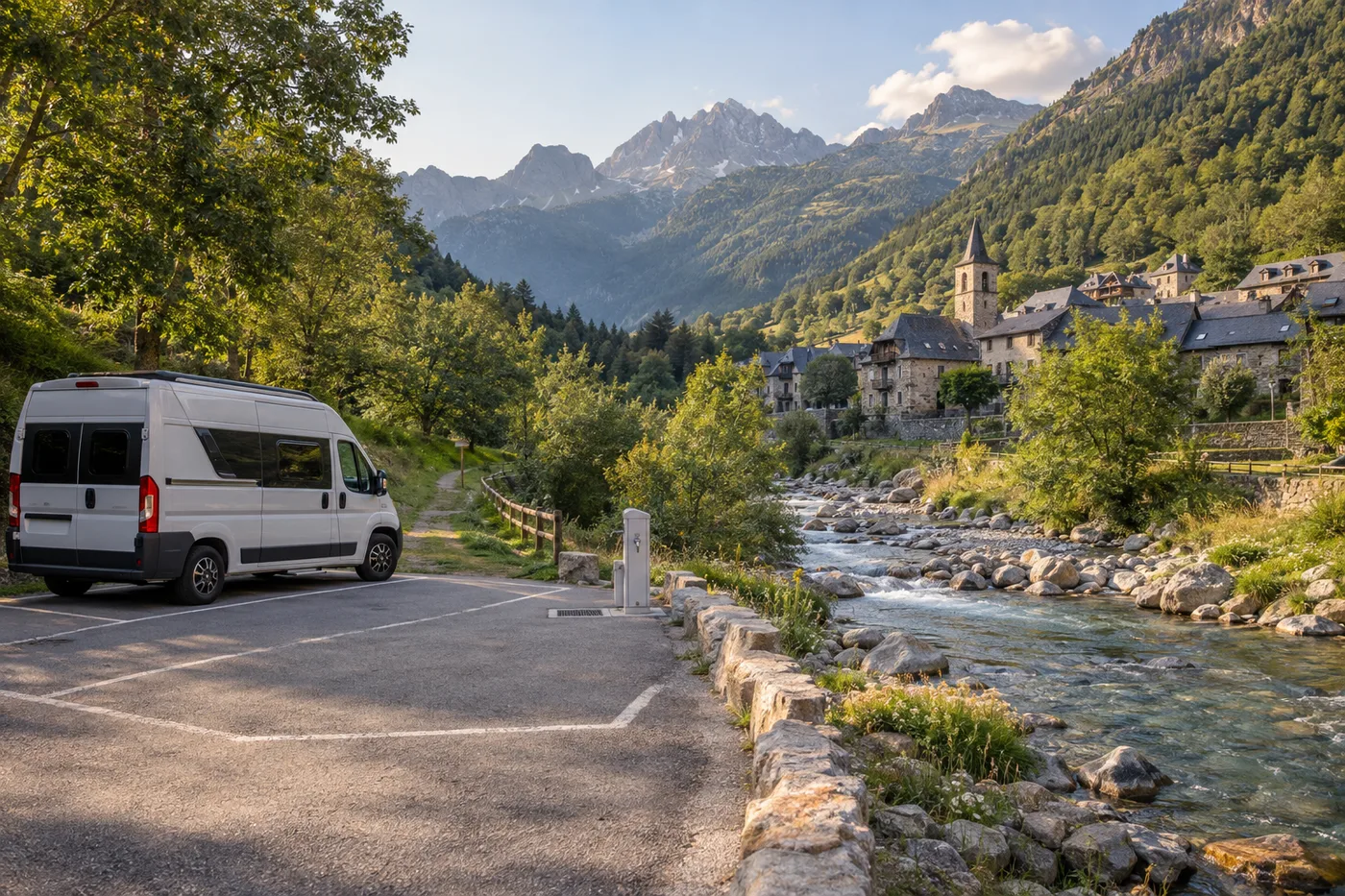
Broto is a practical base because you can reach shops, restaurants and walking routes without parking deep inside the national park. Ordesarea is one current Campernight example with showers, toilets, water and waste disposal shown in its listing. Recent reviews and operating details should still be checked before arrival.
If you want more space or on-site facilities, compare nearby campsites. Choosing a serviced stop here makes the following hiking day easier and reduces pressure on sensitive park access points.
Day 5: Explore Ordesa without sleeping in the visitor car park
Make this a low-driving day. During busy periods, the official Torla-Ordesa shuttle links the car park in Torla with La Pradera de Ordesa. The published 2026 schedule includes service from 1 to 20 September, but operating dates and times vary through the season and can change. Check the official timetable before leaving your overnight base.
The Torla-Ordesa car park is useful for the shuttle, but the official access information states that overnight stays are not permitted there. Return to a legal overnight area or campsite after your walk rather than assuming that daytime parking includes permission to sleep.
Choose a walk that suits the weather, daylight and your group’s fitness. Ordesa is not the place to squeeze a long hike into the final hours of the day. Carry water and a warm layer, and turn back early if cloud, wind or thunderstorms build.
Day 6: Aínsa, Boltaña and a slower valley day
After several high-mountain stages, use the road towards Aínsa and Boltaña as a reset. Explore Aínsa’s old town, restock food and give the van a quick check: tyre condition, coolant level, lights and anything that may have rattled loose on rougher surfaces.
You can spend the night in this area if you want a gentler trip, or continue partway towards the Val d’Aran. The important decision is not the number of kilometres covered; it is avoiding a tired late arrival on unfamiliar mountain roads.
Day 7: Finish in the Val d’Aran
Continue east and north towards Vielha and the Val d’Aran. This final stage links broad valleys, river scenery and stone villages. Base yourself in a designated area or campsite, then use the afternoon for an easy walk or a village visit.
If you have an extra day, keep the van parked and explore locally. A route feels much better when at least one day does not involve packing up, driving and searching for the next night’s stop.
How to choose safe and considerate overnight stops
Rules and local restrictions vary across the Pyrenees. A place that appears suitable on a map may be protected land, day-only parking, seasonally closed or restricted by vehicle height. Use this checklist at every stop:
- Read the signs on arrival. Local signs and barriers take precedence over an app listing or an old review.
- Separate parking from camping. Keeping the vehicle within its space is different from putting out chairs, an awning or levelling equipment.
- Check recent information. Look for current access notes, closure reports and reviews from vehicles similar in size to yours.
- Respect services and waste rules. Empty grey and black water only at authorised points.
- Keep a backup nearby. Mountain stops fill quickly, and turning around after dark is stressful.
- Leave early if conditions change. Heavy rain, strong wind, snow or rockfall risk can turn an easy pass into a poor choice.
Campernight helps with the comparison, but the final check always happens on the ground. Save alternatives before you lose signal and avoid treating isolated parking as permission to camp.
What to pack for a Pyrenees road trip
Even in late summer, valley heat and cold mountain mornings can happen on the same trip. Bring:
- Warm and waterproof layers
- Walking shoes with reliable grip
- Drinking water and a reserve supply
- A basic first-aid kit and sun protection
- Charging cables and an offline navigation backup
- Levelling blocks for designated areas where they are allowed
- Food for at least one evening when shops close earlier than expected
- A head torch and reflective vest
Check your vehicle’s weight, tyres and brakes before the trip. Long descents create heat, so use an appropriate gear and avoid riding the brakes.
Make the route fit your pace
Seven days is enough for this Canfranc-to-Val d’Aran itinerary, but it is not a challenge to complete every stage. The best version of the route may include a second night in Ordesa, a rest day in the Tena Valley or an early stop when the weather turns.
Use the Campernight app to save your preferred overnight stops, compare services and recent community information, and keep backups ready on both sides of the border. Then let the mountains set the pace.