Less Crowded Beach Towns for Campervans After Summer
Beach road trips do not have to end when August does. In September and October, many southern European coastal towns settle into a slower rhythm: the biggest holiday crowds have gone home, daytime temperatures can still suit walking and outdoor meals, and it is often easier to build a flexible route.
That does not mean every beach will be empty or every business will stay open. Weather, local events and school holidays can change the picture quickly. Think of these destinations as good shoulder-season candidates, then use Campernight to check recent reviews, services and realistic overnight options before you arrive.
Why travel the coast after peak summer?
The best reason is not simply fewer people. Post-summer travel changes how you can use a place. You can spend more time walking coastal paths, exploring old centres and choosing stops based on the weather instead of chasing the last available space.
There are trade-offs. Days are shorter, some seasonal campsites and restaurants reduce their hours, sea conditions can change quickly and a quiet car park is not automatically a legal overnight stop. Build each day around two or three possible places, arrive before dark and read current signs when you get there.
1. Sant Pere Pescador, Costa Brava, Spain
Sant Pere Pescador combines a broad sandy coast with the open landscape around the Fluvià river and the Aiguamolls de l'Empordà area. It feels more spacious than the compact resort towns farther south, which makes it a useful base for cycling, beach walks and birdwatching after the busiest weeks of summer.
The town also works well as part of a wider northern Costa Brava route. You can pair it with L'Escala, Empúries or the villages inland without spending the whole trip on crowded seafront roads. Browse campervan spots in Spain before travelling and keep an inland backup if strong wind makes the coast less appealing.
A practical Campernight example is Area Camper Sant Pere Pescador. Its listing places it close to the beach and shows water and waste-disposal services, but always check the latest listing details, reviews and on-site rules before relying on any specific facility.
Best for: long beach walks, cycling and a relaxed Costa Brava base.
2. L'Ametlla de Mar, Catalonia, Spain
L'Ametlla de Mar is a working fishing town surrounded by small coves and rocky stretches of coast. Instead of one long resort strip, the area invites a slower pattern: park in an appropriate place, walk a section of coast, return to town for food and move on when the weather changes.
This is a good choice for travellers who prefer coastal paths and compact coves to large urban beaches. In shoulder season, pack shoes with grip and a light waterproof layer; rocks and paths can remain slippery after rain even when the day begins warm.
Do not assume that a quiet roadside space near a cove allows an overnight stay. Sensitive coastal access, local restrictions and vehicle-size limits still apply outside summer. Use a designated campsite or motorhome area when the signs are unclear.
Best for: cove-hopping, seafood and coastal walking.
3. Agua Amarga, Cabo de Gata, Spain
Agua Amarga is a small whitewashed village on the Almería coast, close to the dry volcanic scenery associated with Cabo de Gata-Níjar. After summer, the contrast between pale buildings, arid hills and the Mediterranean becomes the main attraction rather than the beach-club atmosphere of a large resort.
This is a place to travel slowly. Water, shade and fuel need more attention in a sparsely developed landscape, and mobile signal can vary away from settlements. Protected coastal environments also deserve extra care: stay on established access routes, take waste with you and never treat an empty patch of ground as permission to camp.
Agua Amarga Camper Park is a useful Campernight example of the kind of service-rich base to compare. Its listing shows water, waste disposal, electricity, showers, toilets and Wi-Fi near the beach. Facilities and opening arrangements can change, so verify the current listing and contact the operator when a service is essential.
Best for: dramatic scenery, quiet mornings and a slower nature-focused stop.
4. Carrapateira, Algarve, Portugal
Carrapateira sits on Portugal's wilder western Algarve, where cliffs, dunes and Atlantic beaches replace the denser resort development found farther east. It is especially appealing after summer if you enjoy surfing, walking and big coastal views more than guaranteed swimming weather.
The Atlantic is the deciding factor here. Wind and swell can transform conditions in a few hours, so keep the route flexible and respect beach warnings. Carrapateira is also a small community, not simply a scenic parking backdrop. Use recognised overnight facilities, shop locally when businesses are open and avoid occupying viewpoints or beach access areas.
For route planning, compare Campernight spots in Portugal and save alternatives both north and south. A night near a town with services can be the sensible choice before a more remote day on the coast.
Best for: Atlantic landscapes, surfing and hiking.
5. Le Racou and Argelès-sur-Mer, France
Le Racou, at the southern edge of Argelès-sur-Mer, gives you a useful transition between the broad beaches of the Roussillon plain and the rockier Côte Vermeille. The small lanes and low houses feel distinct from the larger resort zone, while Collioure and the foothills of the Pyrenees are close enough for day trips.
After peak season, this stretch of coast can be a good choice for walking and village-hopping. It can still become busy on warm weekends, and French coastal towns often use clearly regulated parking and motorhome facilities. Follow local signs, height barriers and seasonal notices instead of copying where another van has stopped.
Check campervan spots in France before the trip. If you need certainty, filter for motorhome areas rather than assuming ordinary beach parking is suitable overnight.
Best for: combining beach time with villages and Pyrenean scenery.
6. Sirolo and Numana, Conero Riviera, Italy
Sirolo and Numana sit above and beside the Adriatic on the Conero Riviera. The appeal is the combination of wooded hills, small-town centres and beaches below the cliffs. In early autumn, a campervan lets you adapt the day: walk in the hills when it is cool, visit town in the afternoon and choose a managed place to stay rather than forcing a seafront night.
Access is the key planning issue. Some beaches are reached by steep paths, shuttle services or limited roads, and parking near the historic centres can be tight. Treat the van as a base, not as transport to every viewpoint. Check current local access information before setting out.
Start with Campernight spots in Italy and compare recent reviews carefully. A campsite can be worth the cost here if it gives you a reliable base for a couple of nights while you explore on foot.
Best for: hill-and-sea scenery, walking and small-town evenings.
7. Ribadeo and the western Asturias coast, Spain
Ribadeo, near the Galicia-Asturias border, makes a practical northern-coast base. The surrounding coast is greener and more weather-exposed than the Mediterranean, with cliffs, estuaries and beaches that feel completely different in autumn light.
This is not the destination to choose for guaranteed sunshine. It is the one to choose if you like changeable skies, seafood towns and short scenic walks between showers. Famous coastal sites can still require timed access or special arrangements at certain periods, so check official visitor information rather than arriving with only a pin on a map.
Keep wet-weather options nearby and read the forecast for wind as well as rain. A sheltered motorhome area inland can provide a better night than an exposed seafront space, even if the latter looks more photogenic.
Best for: dramatic Atlantic weather, estuaries and green coastal scenery.
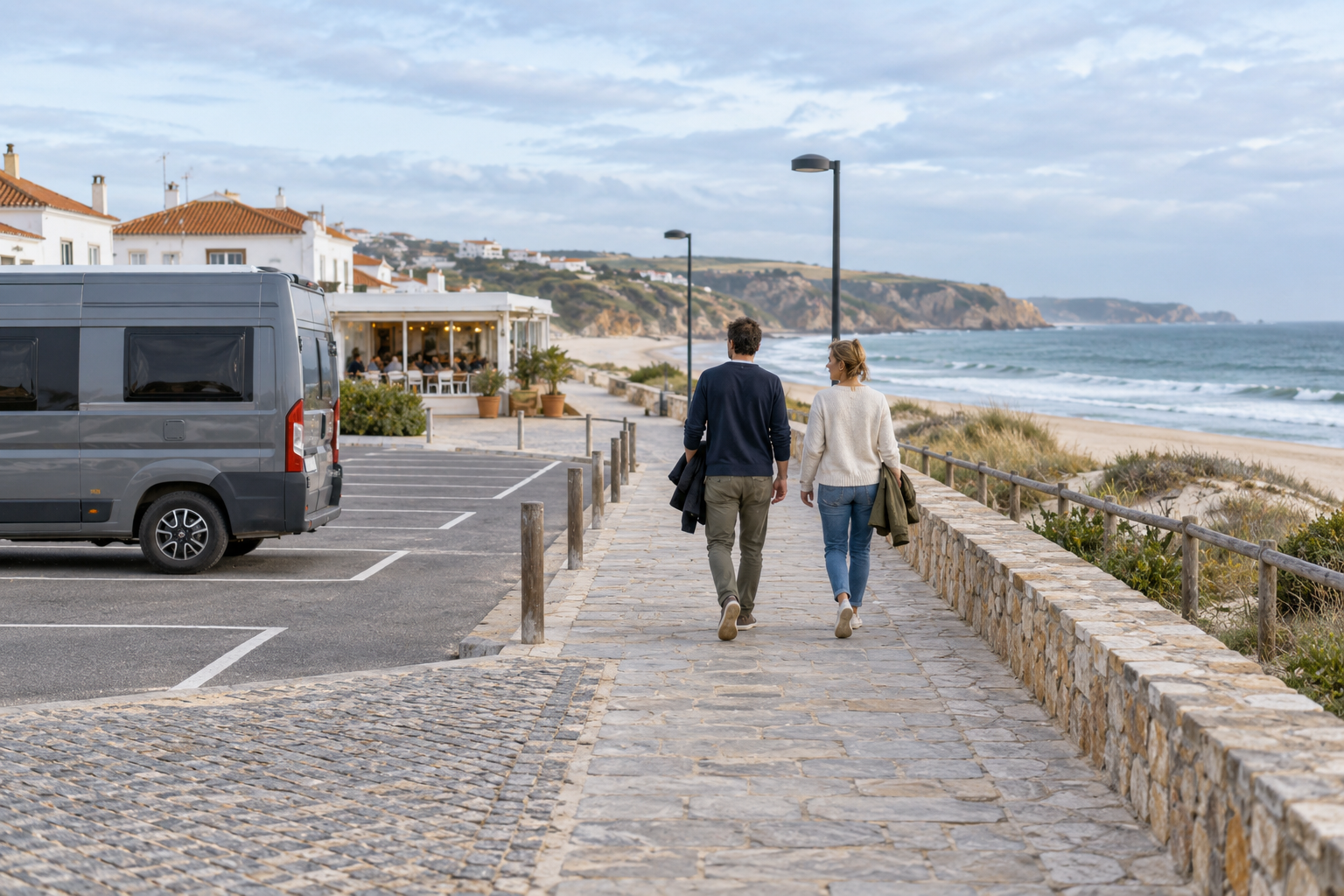
How to choose a genuinely quieter beach stop
The label “off-season” is too broad to be useful on its own. A sunny Saturday, a surf event or a regional holiday can make a small town busier than expected. Use these checks instead:
- Read reviews from the last few weeks, not only the overall score.
- Look for comments about noise, access, height limits, surface conditions and recent restrictions.
- Check whether water, toilets, waste disposal or electricity remain available outside peak season.
- Save one official or managed backup within a comfortable driving distance.
- Arrive with enough daylight to read signs and assess the surroundings.
- Avoid staying where your vehicle blocks residents, sea views, emergency access or beach facilities.
- Keep chairs, tables and awnings inside unless camping behaviour is expressly allowed.
Recent information matters more than a perfect-looking photo. The Campernight app helps you compare map position, place type, services, images and traveller feedback in one place, then save alternatives before you lose signal.
A simple seven-day post-summer route
Do not try to connect every town in this list in one week; they span several countries. Instead, choose one compact coast and build a short loop.
For a northern Catalonia route, spend two nights around Sant Pere Pescador, continue to L'Escala or L'Estartit, then move south to L'Ametlla de Mar. For an Atlantic route, combine Carrapateira with one or two towns on Portugal's southwest coast. For a France-and-Spain trip, link Argelès-sur-Mer with northern Costa Brava stops while keeping the weather forecast in view.
Plan no more than two or three hours of driving on most days. The value of travelling after summer is having time to walk, change plans and stay longer when a place feels right.
Before you leave
Shoulder season rewards flexibility, but it also exposes weak plans. Download offline maps, check campsite opening dates, refill water before remote coastal stretches and keep a proper overnight backup. Never rely on the absence of a prohibition sign alone: local rules, land ownership and protected-area restrictions can all affect where a campervan may stay.
Open Campernight before each move, compare recent information and save at least two realistic options. That small habit turns a vague search for an empty beach into a calmer, more responsible road trip.
The coast after summer is not about having every place to yourself. It is about finding enough space to slow down, support local communities and enjoy the journey without the pressure of peak season.