Free Overnight Campervan Parking in Spain: What Is Actually Allowed?
Free overnight campervan parking in Spain is possible, but the important word is parking. Spain is not a country where you can simply camp anywhere because you arrived in a van. The safe way to think about it is this: if your campervan is legally parked and everything stays inside the vehicle, you are usually in a much stronger position than if your stop starts looking like a campsite.
That distinction matters because Spain has several layers of rules. National traffic guidance, municipal ordinances, regional tourism rules, coastal law, protected-area rules, and the signs in front of you can all affect what is allowed in a specific place.
So the practical answer is not "yes, sleep anywhere" or "no, never sleep for free". The real answer is: you can often sleep inside a correctly parked campervan in permitted parking areas, but you need to avoid camping behaviour, respect local restrictions, and be extra careful near beaches, natural parks, and crowded tourist towns.
This guide explains how to find free overnight parking in Spain without turning your trip into a legal guessing game.
Parking vs camping in Spain
The most useful rule of thumb in Spain is the difference between parking and camping.
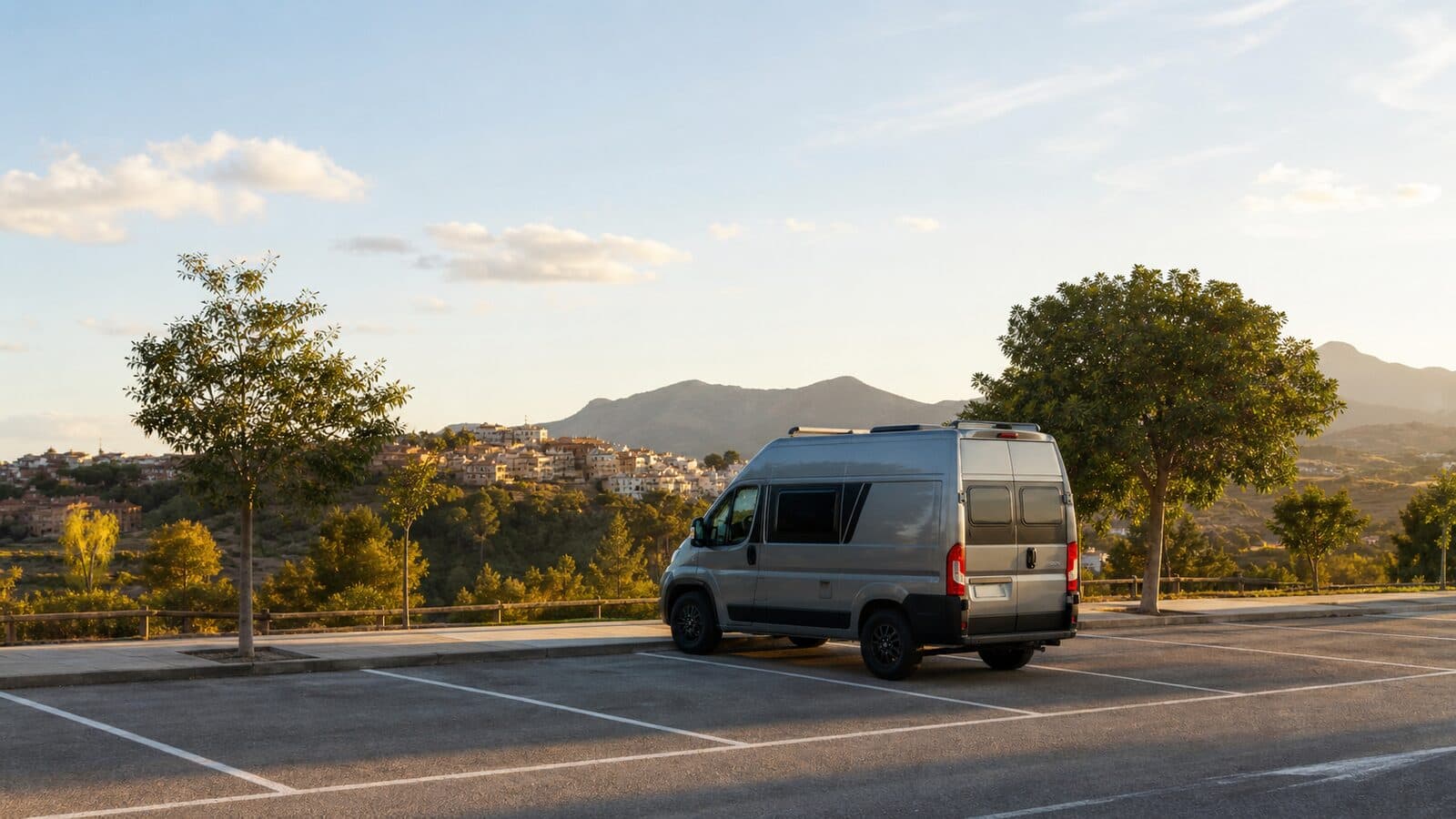
A campervan is parked when it is in a permitted parking place, fits inside the marked bay or allowed area, respects any time limit, and does not extend activity outside the vehicle. Sleeping inside is not, by itself, the key problem. The problem usually starts when the van occupies more public space than a normal parked vehicle or when the stop becomes outdoor accommodation.
Camping behaviour can include:
- Opening an awning
- Putting chairs, tables, mats, cooking gear, or washing outside
- Using stabilisers, levelling legs, or anything that changes the vehicle's footprint
- Making noise, running a generator, or creating nuisance
- Dumping grey water, black water, or rubbish
- Taking over more than one space
If you want the lowest-risk version of a free overnight stop, arrive discreetly, park correctly, keep everything inside, sleep, and leave the place cleaner than you found it.
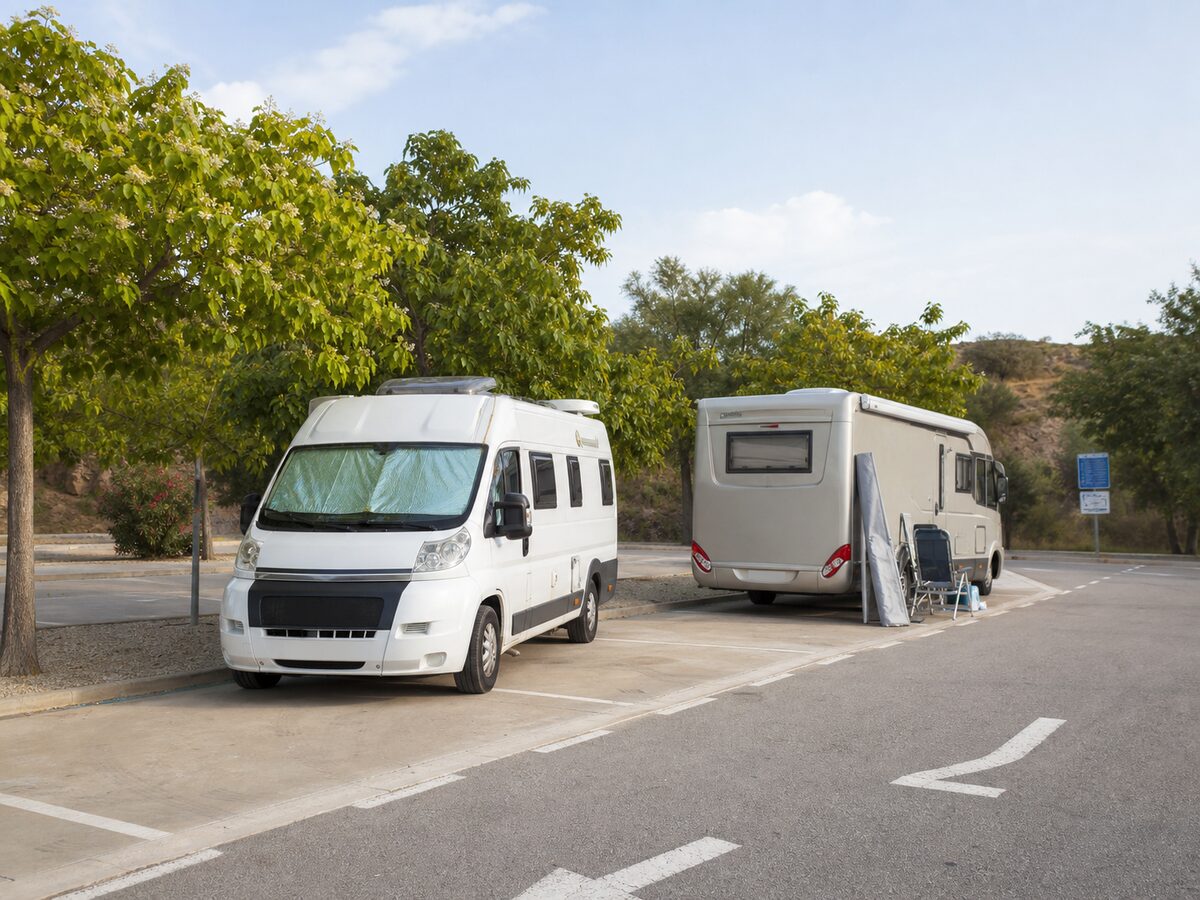
Where free overnight parking is most likely to work
Free overnight parking is most realistic in places that are designed, tolerated, or commonly used for overnight stops without turning into a campsite.
Look first for:
- Official motorhome areas
- Free aires or motorhome service areas
- Large public car parks where overnight parking is not restricted
- Rural town parking areas with clear signage
- Trailhead or viewpoint car parks where overnight stays are not prohibited
- Inland villages outside peak tourist pressure
- Places with recent reviews from other campervan travellers
The best free spots are rarely the most spectacular ones. They are usually practical: flat, quiet, clearly allowed, easy to enter and exit, and not in conflict with residents or local businesses.
This is where Campernight helps. Use the app to shortlist reviewed places before the evening rush, read recent comments, and save at least one fallback nearby. The workflow in How to Find Overnight Parking with Campernight is useful because Spain can change quickly by town, season, and signage.
Where you should be more careful
Some places in Spain need a stricter approach, even if you see other vans parked there.
Be especially cautious around beaches. Spain's coastal rules are protective, and unauthorised vehicle parking or circulation on beaches is not something to treat casually. Even near the beach, municipalities often add seasonal restrictions, height barriers, night parking limits, or campervan-specific signs.
Also be careful in:
- Natural parks and protected landscapes
- Dunes, forests, riverbanks, and sensitive rural tracks
- Old town centres with narrow streets or resident-only parking
- Resort towns in July and August
- Car parks with height barriers or signs banning overnight stays
- Places where many vans are already causing visible pressure
A simple test helps: if your presence would annoy residents, block access, damage the ground, or make the place look like an unofficial campsite, choose another stop.
How to read signs in Spain
Spanish parking signs can be specific, and local rules matter. Before settling in for the night, check the entrance, ticket machines, nearby walls, and any local ordinance signs.
Words and phrases to watch for include:
- Prohibido pernoctar: overnight stay prohibited
- Prohibido acampar: camping prohibited
- Solo turismos: cars only
- Excepto autorizados / residentes: authorised vehicles or residents only
- Altura maxima: maximum height
- Tiempo maximo: maximum stay time
- Autocaravanas: motorhomes/campervans
- Area de autocaravanas: motorhome area
If the sign bans camping but not parking, keep the stop strictly as parking: no awning, no furniture, no outdoor cooking, no stabilisers. If the sign bans overnight stays or campervans specifically, move on.
Free does not mean service-free planning
A free overnight spot can save money, but it should not replace proper service planning. Spain can be hot, dry, and busy in summer. You still need water, toilets, waste disposal, shade, and legal dumping points.
Plan your route around services, not just sleeping pins. A good rhythm is to mix free overnight stops with paid campsites, service areas, or official aires when you need to reset.
Before choosing a free stop, ask:
- Do we have enough water for the night and morning?
- Where is the next legal grey-water and toilet emptying point?
- Is there shade or ventilation if it stays hot overnight?
- Will we need food, fuel, or laundry tomorrow?
- Do we have a backup if the spot is full or restricted?
The cheapest night is not always the smartest night. If a paid campsite gives you showers, laundry, shade, legal certainty, and a calmer evening after several days on the road, it can be the better choice.
A practical search workflow
Use this process when looking for free overnight campervan parking in Spain:
- Choose the area before late afternoon. Do not wait until everyone is tired.
- Search for official campervan areas, municipal parking, or reviewed overnight spots.
- Check recent comments, not just star ratings.
- Look at the access road and vehicle size limits.
- Save one main option and two backups.
- On arrival, read the local signs before switching off.
- Keep everything inside the vehicle.
- Leave early if the place is sensitive, busy, or clearly not intended for long stays.
In Campernight, this is easier if you treat the first spot as a candidate, not a promise. Save alternatives nearby and use reviews to spot problems like height barriers, police checks, noise, full car parks, or seasonal restrictions.
Common mistakes to avoid
The biggest mistake is assuming that because one van slept somewhere, the place is legally or socially acceptable. Spain has many areas where enforcement is local, seasonal, or complaint-driven. What worked in March may not work in August.
Avoid these mistakes:
- Arriving after dark with no backup
- Ignoring signs because other vans are present
- Opening outdoor gear in a normal car park
- Parking on beaches, dunes, tracks, or unmarked natural ground
- Blocking views, doors, farm access, emergency routes, or resident spaces
- Dumping water anywhere outside a proper service point
- Treating a quiet village car park like a free campsite
The better approach is boring but effective: park neatly, stay low-impact, spend money locally when you can, and move if the spot feels wrong.
Is wild camping legal in Spain?
Wild camping spots need careful checks in Spain because the rules can depend on the autonomous community, municipality, land type, protected-area rules, and whether the activity is considered camping rather than parking.
For a broad Europe-wide explanation, read Wild Camping Laws in Europe 2026. For this Spain-specific post, keep the practical distinction clear: sleeping inside a legally parked vehicle is different from setting up camp outside it, but local restrictions can still apply.
If you want a night with chairs, cooking outside, an awning, a longer stay, or certainty near a sensitive area, choose a campsite or official camper area.
Quick checklist before sleeping for free in Spain
- Is parking allowed here for my vehicle size?
- Is there any sign banning overnight stays, campervans, or camping?
- Am I fully inside the marked space or permitted area?
- Will everything stay inside the vehicle?
- Am I away from beaches, dunes, protected areas, and restricted tracks?
- Are there recent reviews from campervan travellers?
- Do I have a legal waste and water plan?
- Is there a backup within 20-30 minutes?
- Would this spot still feel respectful if five more vans arrived?
If the answer to any of these is shaky, move to a better option.
Final take
Free overnight campervan parking in Spain works best when you think like a responsible driver, not like someone looking for loopholes. Park where parking is allowed, keep the stop discreet, avoid anything that looks like camping, and always respect local signs.
The reward is a more relaxed trip: fewer fines, fewer awkward knocks on the window, and fewer bad experiences for the next camper who arrives.
Before your next Spain route, open Campernight, explore overnight campervan spots in Spain, save backups, and cross-check the local rules when you arrive. Free can be great, but legal and respectful is what keeps the trip enjoyable.