Wild Camping Laws in Europe 2026
Wild Camping Laws in Europe 2026
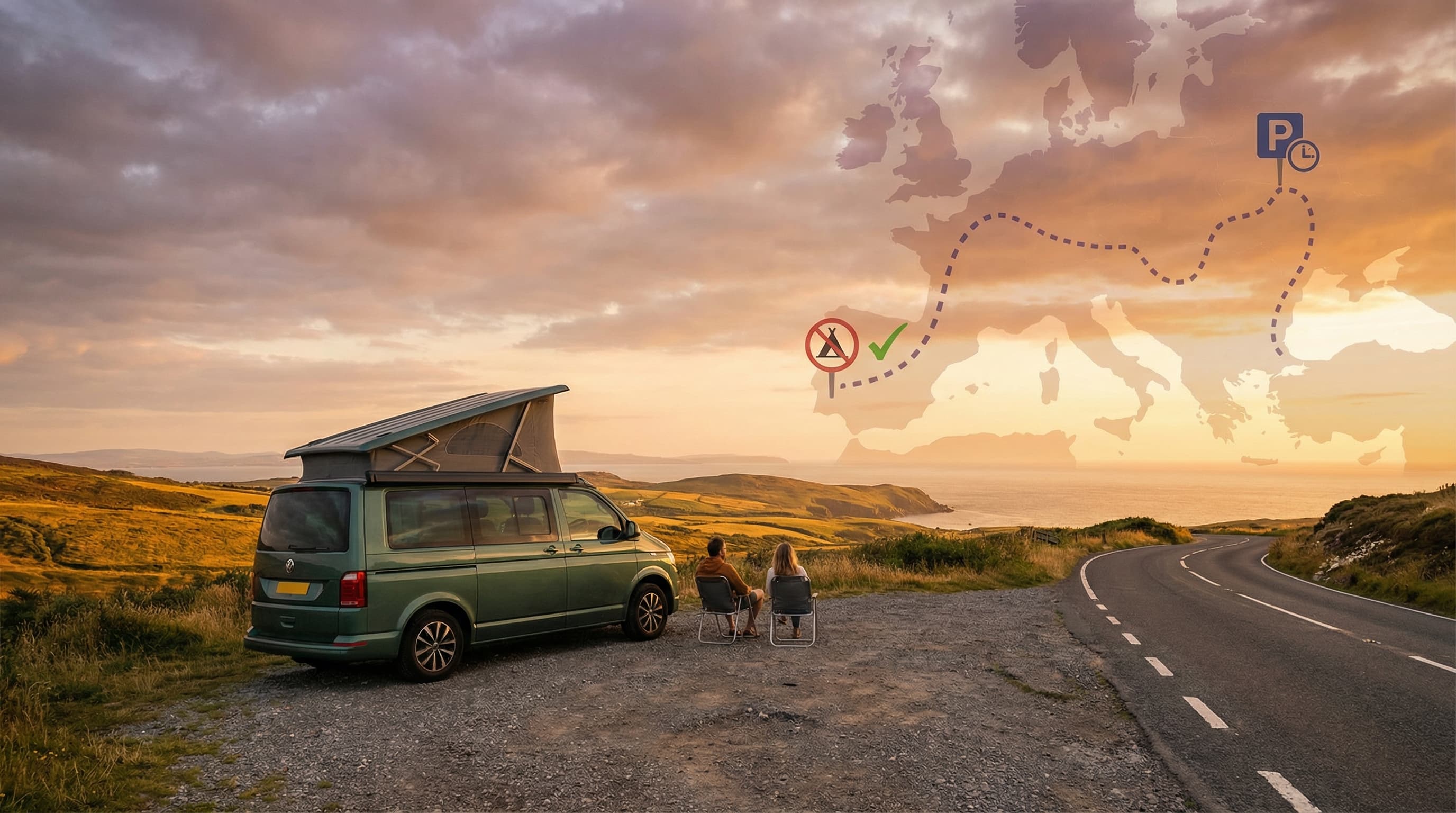
Planning a campervan trip across Europe sounds romantic until you hit the part nobody enjoys: figuring out where you can legally sleep. The tricky part is that “wild camping in Europe” is not one rule. It is a patchwork of national laws, municipal restrictions, protected-area rules, parking regulations, and practical grey areas.
This guide gives you the practical version for 2026. Not legalese, not fantasy vanlife advice, just the stuff that helps you avoid fines, bad assumptions, and stressful last-minute decisions.
Important: Rules can change by country, region, municipality, land type, and season. This guide is for practical trip planning, not legal advice. Before staying overnight, always check local signs, protected-area rules, campsite alternatives, and current municipal restrictions, especially on coasts, in national parks, and in busy tourist areas.
The rule that matters most
Across most of Europe, there is an important difference between:
- Parking overnight in a self-contained campervan or motorhome
- Camping outside the vehicle, for example putting out chairs, awnings, tables, leveling wedges, or cooking gear
That distinction is what catches a lot of people out.
In many countries, sleeping inside a legally parked vehicle is treated more leniently than turning the space into a campsite. The moment your footprint extends beyond the vehicle, the legal situation often gets worse.
If you remember one thing, make it this:
Sleeping is sometimes tolerated. Camping is much more often restricted.
The short version: where it is stricter and where it is more nuanced
Local rules always matter, but this is the practical Europe-wide picture for 2026.
Countries where wild camping is generally quite restricted
These are places where free overnighting outside official areas is often banned, tightly controlled, or risky unless a municipality clearly allows it:
- Netherlands
- Belgium
- Croatia
- Portugal in sensitive coastal and nature areas
- many parts of Italy, depending on regional and municipal rules
- many tourist-heavy coastal areas across southern Europe
In these places, assume you will need an official camper area, campsite, or clearly permitted parking place unless you have strong evidence otherwise.
Countries where overnight parking may be tolerated more than full camping
Here, the difference between a parked vehicle and camping behaviour matters a lot:
- France
- Spain
- Germany
- Austria
- parts of Italy
- parts of Switzerland
A discreet overnight stay may be possible in some places, but local bylaws, environmental zones, beach restrictions, and parking signs can override that quickly.
Countries with stronger nature access, but not unlimited vehicle freedom
- Norway
- Sweden
- Finland
Scandinavia has the strongest reputation for freedom, and some of that reputation is deserved. But campervans are not automatically covered by the same rules as hikers with a tent. Road access, protected land, distance from homes, and local restrictions still matter.
Tent rights and vehicle rights are not the same thing here, especially in Sweden and Finland.
What “wild camping” actually means
People use the term loosely, which causes half the confusion.
Depending on the country, “wild camping” may refer to one or more of these:
- sleeping in a vehicle outside designated areas
- sleeping in a tent outside designated areas
- staying overnight on beaches, dunes, forests, or natural parks
- occupying a parking place like a campsite
- staying on private land without permission
That is why the answer to “is wild camping legal?” is often messy. It may be:
- No for tents
- Sometimes for self-contained vans
- Yes only with landowner permission
- No in protected areas
- Allowed only as a temporary one-night rest stop
If a blog post or forum gives a simple yes-or-no answer for an entire country, it is probably oversimplifying.
Europe 2026: practical country-by-country guidance
This is not a substitute for local signs and municipal rules, but it is a solid planning baseline.
France
France is one of the easier countries for campervan travel, but that does not mean total freedom.
In practice:
- Sleeping in a properly parked campervan is often treated more leniently than setting up an outdoor camp
- Wild camping is restricted in many protected, coastal, and locally regulated areas
- Municipal signs matter a lot
- Aires and official motorhome areas make France much easier than many neighbours
Best approach: avoid setting up outside the vehicle, respect local parking controls, and use aires whenever you want a low-cost legal overnight.
Spain
Spain is famous for rule confusion because the distinction between parking and camping is so important.
In practice:
- A correctly parked vehicle is often treated differently from a camping setup
- Sleeping inside a legally parked vehicle may be tolerated
- Putting out chairs, awnings, steps, leveling blocks, or anything that extends your footprint can trigger fines fast
- Coastal towns, beach areas, and natural parks are usually stricter than inland areas
- Local police and municipal ordinances matter more than generic internet advice
Best approach: think like you are parking, not camping. Be discreet, self-contained, and especially careful near the coast.
Portugal
Portugal has tightened rules significantly, especially in protected and coastal areas.
In practice:
- Motorhome overnight rules are stricter than they used to be
- Overnight stays outside authorised places are much riskier than before
- Enforcement is more serious in popular surf and beach regions
- Nature protection is a major factor
- Official camper parks and authorised overnight areas are the safe play
Best approach: do not rely on old vanlife advice from pre-2021 blog posts. Portugal is now a country where casual wild camping is usually a bad bet.
Germany
Germany is more nuanced than many travellers expect.
In practice:
- A short overnight stop to restore driving fitness is sometimes treated differently from recreational camping
- That is not the same as general wild camping
- Long stays, camping behaviour, and scenic occupation of public parking are another story
- Local rules and private land access still matter
- Stellplätze make legal overnighting much easier
Best approach: use official motorhome stopovers when possible. If you stop for rest, keep it genuinely minimal and temporary.
Netherlands
The Netherlands is one of the least promising countries for wild camping.
In practice:
- Free overnighting outside official areas is generally not something to count on
- Space is limited, enforcement is real, and tolerated grey zones are rare
- Official camperplaatsen are the normal answer
Best approach: plan official stops in advance. This is not the country for improvising late at night.
Belgium
Belgium is also relatively strict.
In practice:
- Wild camping is generally restricted
- Discreet sleeping in a van is not something you should assume is acceptable
- Official stopovers, campsites, and specific allowed zones are the safer option
Best approach: treat Belgium as a country where official overnight places matter.
Italy
Italy is beautiful, inconsistent, and very local.
In practice:
- Italy is often restrictive in practice, but it is not uniform nationwide
- Rules vary heavily by municipality
- Coastal and tourist areas can be strict
- The distinction between simple vehicle parking and camping behaviour matters in many places
- Camper areas are common enough to avoid gambling on unclear spots
Best approach: never assume an Italy-wide answer. Check the town, not just the country.
Norway, Sweden, Finland
These countries are often grouped together, but they are not identical.
In practice:
- Outdoor access traditions are stronger than in much of Europe
- Norway is especially strong for tent-based roaming under the right to roam, but still excludes cultivated land, the immediate area around homes and cabins, and some locally restricted sites
- Sweden’s right of public access is generous for low-impact tent camping, but it does not automatically mean you can park or sleep in a campervan anywhere
- Finland’s everyman’s rights are broad for respectful, temporary access to nature, but they do not override road rules, private-property boundaries, or protected-area restrictions for vehicles
- Campervans still face road, parking, and local land-use limits across all three
Best approach: use the extra flexibility respectfully. Stay away from homes, avoid damage, follow access rules, and do not turn scenic lay-bys into campsites.
The 7 rules that keep you out of trouble almost everywhere
If you want a simple system that works across Europe, use this.
1. Read signs like they matter, because they do
A country may seem camper-friendly, but one local sign can still make your overnight stop illegal.
Watch for:
- no overnight parking signs
- motorhome restrictions
- height barriers
- protected area notices
- private property warnings
- beach or coastal access limitations
If signage is clear, do not try to lawyer your way around it.
2. Stay smaller than a campsite
If you want the safest interpretation, remain a parked vehicle.
That means:
- no awning
- no chairs
- no table
- no outdoor cooking setup
- no wedges unless clearly necessary and tolerated
- no gear spilling into the parking space or beyond it
This one rule prevents a ridiculous number of problems.
3. Avoid protected nature and beachfront hotspots
Even where overnighting is sometimes tolerated, these are the places most likely to be restricted or enforced.
Bad bets include:
- dunes
- beaches
- clifftops
- nature reserves
- national parks
- famous lakeside viewpoints
- tourist seafront parking lots in peak season
Beautiful does not mean legal.
4. Never assume private land is fair game
If the land is private, permission is the only clean answer.
In rural Europe, asking can sometimes work surprisingly well. Guessing does not.
5. Arrive late, leave early, leave nothing
This is partly etiquette and partly risk management.
A discreet overnight stop is less likely to create problems than treating a scenic parking lot like your personal campsite.
6. Use official stopovers strategically
You do not need to use campsites every night. But mixing in official aires, stellplätze, camper areas, and legal parking zones makes the whole trip easier.
It also gives you a fallback when weather, fatigue, or local rules kill your original plan.
7. Have a Plan B before sunset
This is the real trick.
Most bad overnight decisions happen when people are tired, it is getting dark, and they are emotionally committed to a spot that feels convenient.
Find two or three backups before you need them.
The biggest myth: “If nobody complains, it’s legal”
Nope.
A quiet night without a knock on the door does not prove legality. It only means enforcement did not happen that time.
If you are planning a summer trip through Europe in 2026, you want a system that is repeatable, not gambling disguised as vanlife freedom.
How Campernight helps with this
The smartest way to handle European overnight rules is not trying to memorise every law in every country. That is a good way to go slightly insane.
A better approach is:
- understand the country-level pattern
- check local restrictions
- avoid obvious red-flag areas
- keep backup options nearby
- use verified overnight spots when the legal picture is messy
That is where Campernight is useful. Instead of improvising blind, you can look for camper spots, parking options, and practical alternatives before you end up circling in the dark.
Final answer: is wild camping legal in Europe in 2026?
As a general rule, no, not in the simple romantic sense people imagine.
Across Europe, fully free wild camping is usually restricted, locally controlled, or allowed only in limited contexts. What is sometimes possible is a more discreet form of overnight parking in a self-contained vehicle, and even that depends on country, municipality, signage, land type, and behaviour.
So the winning strategy for 2026 is not “find out how much I can get away with.”
It is this:
Know the difference between parking and camping, respect local rules, avoid protected hotspots, and always keep a legal backup nearby.